How to Best Prevent House Fires Ca Gov
Afterwards a wildfire passes through a community, many wonder why ane home survived and another did not. Whether you are a homeowner, contractor, or renter, there is good news - research indicates that wise decisions regarding fabric choices, design and installation options, and maintenance considerations tin can improve the odds that your domicile will survive a future wildfire. Hardening a building to withstand wildland fire exposure does not have to be costly, merely it does crave an understanding of the exposures your home will experience when threatened by a wildfire.
How fires spread
Wildland fires are spread by a moving flame front and the current of air distribution of burning embers. Embers are small pieces of plants, trees, or buildings that are lite enough to be blown through the air and can result in the rapid spread of wildfire where embers are blown alee of the main fire, starting new fires.
How homes burn
Home and building loss during wildfires occur as a result of some part of the edifice igniting from i or more of the 3 basic wildfire exposures: 1) direct flame contact, 2) embers, three) radiant oestrus.

Embers crusade the majority of wildfire habitation ignition by directly igniting your abode or igniting vegetation or materials on or near your home that results in flames touching your house or a loftier oestrus (radiant heat) exposure that may suspension glass in a window. Should embers land on or most your house, they accumulate (like hail or snow) and tin easily ignite the plants and mulch near your dwelling, dry leaves, or lawn furniture. They also country on the roof, deck, or porch and, depending on the condition of each, they may notice a gap to enter the firm or catch accumulated dry leaves on fire. Embers can also enter the home or attic through a vent or open window. When embers enter the home or attic, they can easily ignite the contents of the house, and the dwelling will burn seemingly from the within out. When ember enter the house directly, in that location is often little impairment to the surrounding vegetation, and many are left puzzled equally to what acquired the home to burn.
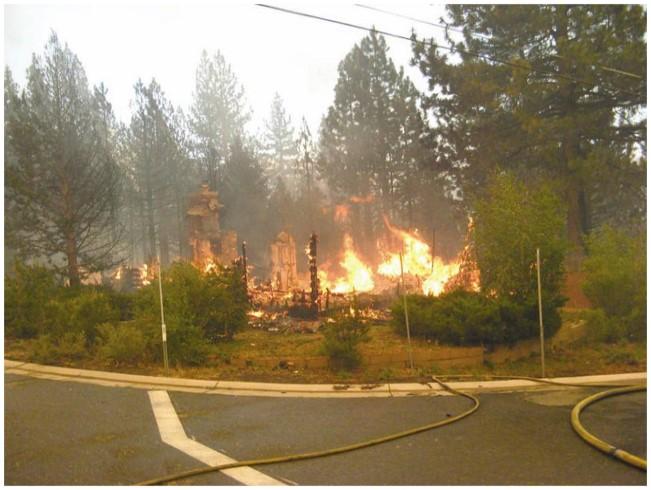
Structure fire with minimal direct damage to surrounding vegetation
What yous can do
Homes survive wildfire through a combination of:
1) conscientious mural selection, placement, and maintenance
two) awareness and direction of combustible materials on the belongings (e.g., foliage litter or lawn furniture) during your fire season
iii) incorporation of fire and ember resistant construction materials, installation details and maintenance.
Use the suggestions below to learn how to harden your home by reducing its vulnerability. Keep in mind that developing wildfire resilience is more than than having a metallic roof or stucco siding.
Ember-resistant structure relies on awareness of seemingly small details that can make your home vulnerable to embers, in improver to building with advisable materials, and regular domicile and holding maintenance.
The following table summarizes the vulnerabilities of your domicile and recommends deportment. Each of the components of the home are prioritized to offering some general guidance; however, each situation is unique. If your neighbor'due south firm is close to y'all the lower priority items increment in their importance because of the potential that your neighbor's home tin can catch on fire and send embers to your business firm or provide an extended radiant oestrus exposure.
| Priority | Function and Wildfire Vulnerability | Recommendations |
| #one Roof | Because your roof is a large horizontal surface, it is arguably the near vulnerable component of your abode. The job of the roof is to protect the house from sun, rain, and during fire, from embers. Complex roofs, where the roof meets vertical walls and/or includes dormers present additional vulnerabilities. | Use materials with a Class A fire rating. Advisedly follow the manufacturers installation instructions because some roof coverings need additional protection to run into the Class A requirements. Common Class A fire-rated materials include asphalt composition shingles, tile, and steel. Install with a metal drip border at the roof border. Clean out and maintain gutters. Plug gaps between the roof covering and sheathing. Maintain your roof and supercede when necessary. |
| #1 Vents | Vents provide ii important functions. Vents permit for air circulation to reduce the heat in your attic and allow moisture to escape that tin can atomic number 82 to moisture degradation issues over fourth dimension. Embers can easily sideslip through foundation, roof, or attic vents. Once within, embers can ignite debris and items stored inside the business firm. | Movement combustible items away from vents both inside and outside the house. Replace 1/4" mesh vents with 1/eight" mesh or install vents that meet new ember and flame resistant requirements. Regularly cheque vents and remove materials that may plug vent openings. Fix temporary plywood vent covers to install prior to the approach of a wildfire, if yous take sufficient preparation fourth dimension. Or consider using metal record to temporarily seal up vents from the inside of the house. |
| #ane Vegetation | All plants tin burn during a wildfire. Placement of landscaping vegetation and combustible mulch immediately around your home, and under windows, eaves, and vents can provide a fashion for burn down to enter the domicile. Embers tin can easily be diddled across a dark-green lawn and ignite vegetation adjacent to the house. Leaf litter and needles can accumulate in or on rooves, gutters, decks, porches, and next to the house. The aforementioned challenges apply to outbuildings, sheds, and discrete garages. In add-on to your dwelling, vegetation direction treatments should also be given to these structures using the aforementioned zone approach. | Dwelling house Ignition Zones: Three abode ignition zones Zone 1. 0-5 feet. This is highest priority zone. Start with the business firm and piece of work outwards by creating a 5-feet broad noncombustible zone effectually the entire house (and under the deck) to reduce the potential for an ignition by wind-blown embers. If ignited, these materials will outcome in a direct flame contact to the business firm. Use hardscape (pavers or crushed stone), maintained lawn, or low-cut grass. Cutting tree branches that overhang the house. Zone ii. 5-thirty feet. Lean and green zone. The goal is to reduce the intensity of the burn and potential for ember generation from the mural. Copse and taller vegetation should exist well-maintained separated from the house and each other. Remove vegetation under trees to prevent burn from climbing to the top of the trees. Clip mature trees up to 6-x feet from the basis. Landscaping in this area should include depression growing, open structured, less resinous, higher wet content plants. Zone 3. 30-100 feet or holding line. Reduced fuel zone. The goal is to interrupt the fire and continue flames on the basis. Remove or dispose of tree needles or leaves, remove dead trees, thin out minor trees and shrubs creating islands of vegetation, limb and prune mature trees up to 6-10 anxiety. Thin mature trees and so that canopies do not touch. |
| #2 Decks | Decks are vulnerable to fires from embers igniting vegetation or stored materials igniting below the deck or ignition of the top of the deck. Leaves and needles can build upward in gaps between deck boards, creating targets for embers to ignite. On peak of decks embers can also land wood furniture, door mats, brooms, umbrellas, or plants that are easily ignitable. If the deck ignites, information technology volition provide a flame exposure to either the exterior wall and under-eave surface area. | Clean and maintain the deck by removing debris that can accumulate on the deck and in the between deck lath gaps. Practise non store flammable materials under the deck. Before evacuating bring combustible door mats, brooms and piece of furniture cushions inside. Movement deck piece of furniture off the deck. Movement bar-b-que propane tanks away from the house. For new deck installation, when non-fire retardant treated forest is used:
|
| #three Windows | As a burn down approaches, close all windows and skylights to forestall ember entry. The glass is the near vulnerable part of the window. Multi-pane tempered glass is best because information technology distributes the heat load and provides a second layer of protection if the beginning pane fails. Larger windows are more vulnerable than smaller windows. For vinyl windows confirm there is a vertical or horizonal reinforcement bar. | Install or upgrade to multi-pane tempered glass windows. Remove vegetation immediately outside of the windows. When a neighboring dwelling house or building is inside 30 anxiety of your home; consider installing noncombustible shutters to shut upon evacuation or comprehend your windows with temporary plywood covers prior to evacuating. |
| #4 Eaves | The eave overhang protects your home from rain and sun. Depending on design, it also tin trap heat and allow embers to enter through nether-eave attic vents. With open-eave structure gaps between the rafter tails and the blocking can be vulnerable to ember entry. Soffited eaves (boxed-in) are more robust to embers. | With open-eave construction inspect eaves for gaps around rafter roof tails and blocking. Plug or caulk gaps. If possible, create a soffited eave where an open-eave design exists. Vents should be upgraded to 1/8" metal mesh screening. Remove vegetation and combustible materials beneath eaves. |
| #5 Siding | Siding is vulnerable if exposed to flames or radiant estrus for extended periods. A carefully developed and maintained home ignition zone will minimize the potential for this exposure. Where neighboring homes are inside thirty feet of your home, use of a noncombustible or ignition resistant materials would reduce the vulnerability of your home. Gaps and joints in siding can create places where flame penetration can occur. Poorly maintained or degraded siding is as well vulnerable to flame penetration. Many homes with stucco, cinder block, or fiber cement siding are lost to wildfire because other pattern and maintenance considerations have not been followed or have been overlooked, assuasive embers to either ignite external materials or penetrate into the building. In general, combustible panels and horizontal siding with more complicated lap joints (e.g., natural language and groove and ship lap) are more resistant to flame penetration into the stud crenel. | Along with the v' noncombustible horizontal zone, maintain a six" noncombustible vertical zone between the ground (and other horizontal surfaces) and the outset of the siding. Inspect all siding and plug or caulk gaps and joints. If a neighbor'south house or an outbuilding is shut to the house, a fire-retardant gypsum lath can be installed under the siding to increase the burn down-resistance of the wall should the siding ignite. Gel coatings are hard to install and are limited in the number of hours that they provide protection; therefore, they are not recommended. |
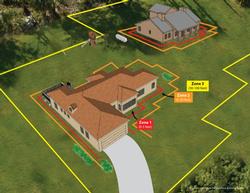
Source: https://ucanr.edu/sites/fire/Prepare/Building/
0 Response to "How to Best Prevent House Fires Ca Gov"
Post a Comment