If You Read This You May Never Eat Chicken Again
E very twelvemonth I spend some time in a tiny apartment in Paris, seven storeys above the mayor's offices for the 11th arrondissement. The Place de la Guardhouse – the spot where the French revolution sparked political alter that transformed the world – is a x-minute walk downwards a narrow street that threads between student nightclubs and Chinese fabric wholesalers.
Twice a week, hundreds of Parisians crowd down it, heading to the marché de la Guardhouse, stretched out along the center isle of the Boulevard Richard Lenoir.
Blocks before y'all accomplish the market, you can hear it: a low hum of argument and churr, punctuated by dollies thumping over the curbstones and vendors shouting deals. But even before you hear it, yous tin can smell it: the funk of bruised cabbage leaves underfoot, the precipitous sugariness of fruit sliced open up for samples, the iodine tang of seaweed propping upward rafts of scallops in broad rose-colored shells.
Threaded through them is ane scent that I wait for. Burnished and herbal, salty and slightly burned, it has so much heft that it feels concrete, similar an arm slid around your shoulders to urge you to motility a little faster. It leads to a tented booth in the middle of the market and a line of customers that wraps around the tent poles and trails downward the market alley, tangling with the crowd in front end of the flower seller.
In the middle of the booth is a closet-size metallic chiffonier, propped upwards on iron wheels and bricks. Inside the cabinet, flattened chickens are speared on rotisserie bars that accept been turning since before dawn. Every few minutes, 1 of the workers detaches a bar, slides off its dripping bronze contents, slips the chickens into flat foil-lined numberless, and hands them to the customers who have persisted to the head of the line.
I can barely wait to get my chicken home.
* * *
The pare of a poulet crapaudine – named considering its spatchcocked outline resembles a crapaud, a toad – shatters like mica; the mankind underneath, basted for hours by the birds dripping on to it from above, is pillowy just springy, imbued to the os with pepper and thyme.
The kickoff time I ate information technology, I was stunned into happy silence, too intoxicated by the feel to process why it felt and so new. The second time, I was delighted once again –and then, afterward, sulky and sad.
I had eaten chicken all my life: in my grandmother's kitchen in Brooklyn, in my parents' firm in Houston, in a college dining hall, friends' apartments, restaurants and fast food places, trendy bars in cities and old-school joints on back roads in the south. I thought I roasted a chicken pretty well myself. But none of them were ever like this, mineral and lush and direct.
I thought of the chickens I'd grown upwards eating. They tasted like whatever the cook added to them: canned soup in my grandmother's fricassee, her party dish; soy sauce and sesame in the stir fries my college housemate brought from her aunt's restaurant; lemon juice when my mother worried well-nigh my father'due south blood pressure and banned salt from the house.
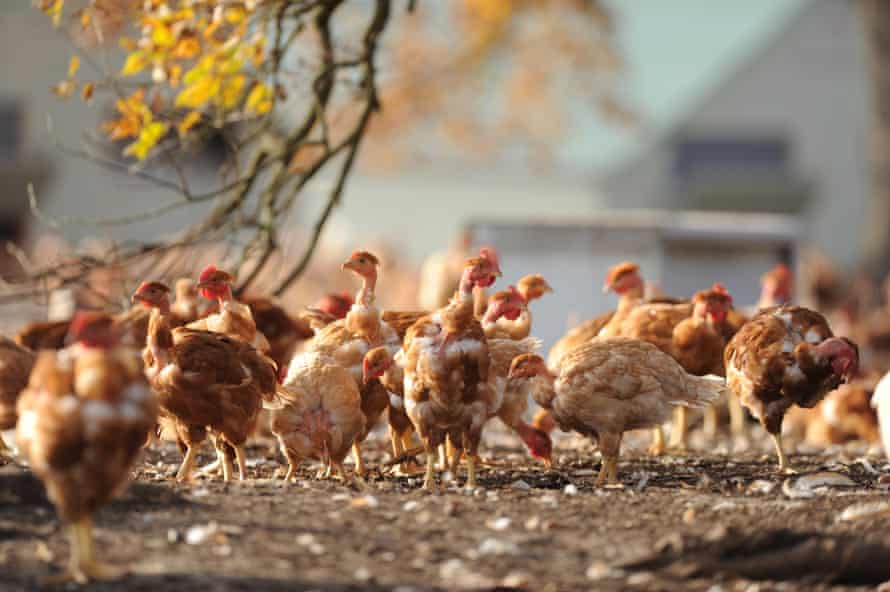
This French chicken tasted like musculus and blood and do and the outdoors. It tasted like something that it was too like shooting fish in a barrel to pretend it was not: like an animal, like a living thing. We accept made it easy not to think about what chickens were before nosotros find them on our plates or pluck them from supermarket cold cases.
I alive, nearly of the time, less than an hour's drive from Gainesville, Georgia, the self-described poultry capital of the earth, where the modern craven manufacture was born. Georgia raises 1.4bn broilers a twelvemonth, making it the unmarried biggest correspondent to the almost 9bn birds raised each yr in the United States; if it were an independent state, it would rank in craven production somewhere nearly China and Brazil.
All the same yous could drive around for hours without ever knowing you lot were in the heart of chicken land unless you happened to go behind a truck heaped with crates of birds on their way from the remote solid-walled barns they are raised in to the gated slaughter plants where they are turned into meat. That first French marketplace chicken opened my eyes to how invisible chickens had been for me, and subsequently that, my job began to show me what that invisibility had masked.
My house is less than 2 miles from the forepart gate of the Centers for Disease Control and Prevention, the federal agency that sends disease detectives racing to outbreaks all over the world. For more than than a decade, one of my obsessions equally a announcer has been following them on their investigations – and in long late-dark conversations in the Usa and Asia and Africa, with physicians and veterinarians and epidemiologists, I learned that the chickens that had surprised me and the epidemics that fascinated me were more than closely linked than I had ever realized.
I discovered that the reason American chicken tastes so different from those I ate everywhere else was that in the The states, we breed for everything but flavor: for affluence, for consistency, for speed. Many things made that transformation possible.
Just as I came to understand, the single biggest influence was that, consistently over decades, we have been feeding chickens, and near every other meat animal, routine doses of antibiotics on almost every twenty-four hours of their lives.
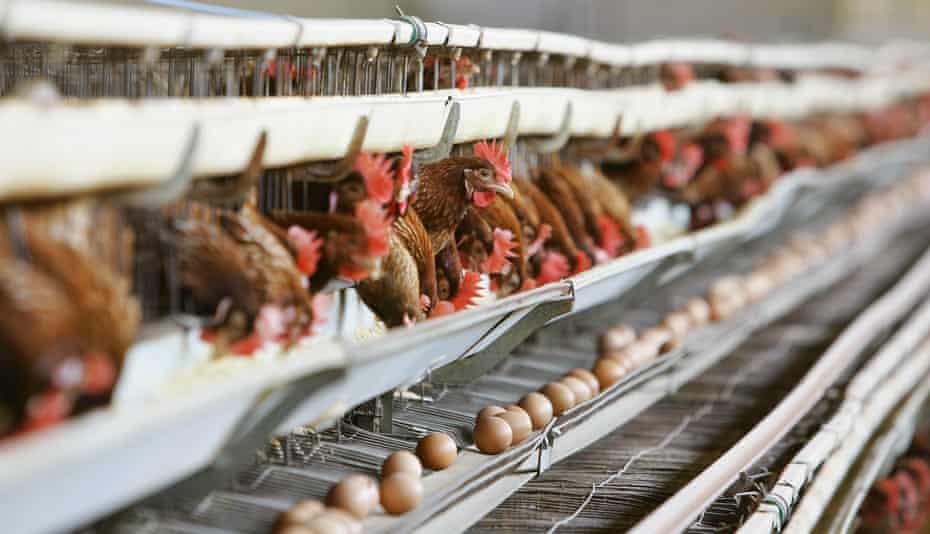
Antibiotics do not create blandness, but they created the weather condition that allowed craven to be bland, assuasive us to plough a skittish, active backyard bird into a fast-growing, irksome-moving, docile block of protein, equally muscle-bound and top-heavy as a bodybuilder in a kids' cartoon. At this moment, well-nigh meat animals, beyond well-nigh of the planet, are raised with the assistance of doses of antibiotics on most days of their lives: 63,151 tons of antibiotics per year, virtually 126m pounds.
Farmers began using the drugs considering antibiotics allowed animals to convert feed to tasty muscle more efficiently; when that result made it irresistible to pack more than livestock into barns, antibiotics protected animals against the likelihood of disease. Those discoveries, which began with chickens, created "what we choose to phone call industrialized agriculture", a poultry historian living in Georgia proudly wrote in 1971.
Chicken prices fell then low that it became the meat that Americans eat more than any other – and the meat almost probable to transmit nutrient-borne illness, and also antibiotic resistance, the greatest irksome-brewing health crisis of our fourth dimension.
For near people, antibiotic resistance is a hidden epidemic unless they have the misfortune to contract an infection themselves or have a family unit member or friend unlucky enough to get infected.
Drug-resistant infections have no celebrity spokespeople, negligible political back up and few patients' organizations advocating for them. If we call back of resistant infections, we imagine them as something rare, occurring to people unlike us, whoever we are: people who are in nursing homes at the finish of their lives, or dealing with the drain of chronic illness, or in intensive-intendance units after terrible trauma. Just resistant infections are a vast and mutual problem that occur in every part of daily life: to children in daycare, athletes playing sports, teens going for piercings, people getting healthy in the gym.
And though mutual, resistant leaner are a grave threat and getting worse.
They are responsible for at least 700,000 deaths around the world each year: 23,000 in the United states of america, 25,000 in Europe, more than 63,000 babies in Bharat. Across those deaths, leaner that are resistant to antibiotics cause millions of illnesses – 2m annually just in the United States – and cost billions in healthcare spending, lost wages and lost national productivity.
It is predicted that past 2050, antibody resistance volition price the world $100tn and will crusade a staggering 10m deaths per yr.
Disease organisms have been developing defenses against the antibiotics meant to kill them for as long as antibiotics have existed. Penicillin arrived in the 1940s, and resistance to it swept the world in the 1950s.
Tetracycline arrived in 1948, and resistance was nibbling at its effectiveness before the 1950s concluded. Erythromycin was discovered in 1952, and erythromycin resistance arrived in 1955. Methicillin, a lab-synthesized relative of penicillin, was adult in 1960 specifically to counter penicillin resistance, still within a year, staph bacteria adult defenses against it likewise, earning the bug the name MRSA, methicillin-resistant Staphylococcus aureus.
After MRSA, in that location were the ESBLs, extended-spectrum beta-lactamases, which defeated not simply penicillin and its relatives merely also a large family unit of antibiotics called cephalosporins. And after cephalosporins were undermined, new antibiotics were achieved and lost in turn.
Each time pharmaceutical chemical science produced a new grade of antibiotics, with a new molecular shape and a new mode of action, bacteria adapted. In fact, as the decades passed, they seemed to adapt faster than earlier. Their persistence threatened to inaugurate a mail-antibiotic era, in which surgery could be also dangerous to endeavor and ordinary health problems – scrapes, molar extractions, broken limbs – could pose a deadly risk.
For a long fourth dimension, it was assumed that the extraordinary unspooling of antibiotic resistance around the world was due simply to misuse of the drugs in medicine: to parents begging for the drugs even though their children had viral illnesses that antibiotics could non assistance; physicians prescribing antibiotics without checking to see whether the drug they chose was a proficient match; people stopping their prescriptions halfway through the prescribed course considering they felt improve, or saving some pills for friends without health insurance, or buying antibiotics over the counter, in the many countries where they are available that way and dosing themselves.
Only from the earliest days of the antibody era, the drugs have had another, parallel utilize: in animals that are grown to go food.
Lxxx percent of the antibiotics sold in the United States and more than than one-half of those sold effectually the world are used in animals, non in humans. Animals destined to be meat routinely receive antibiotics in their feed and water, and most of those drugs are not given to treat diseases, which is how nosotros employ them in people.
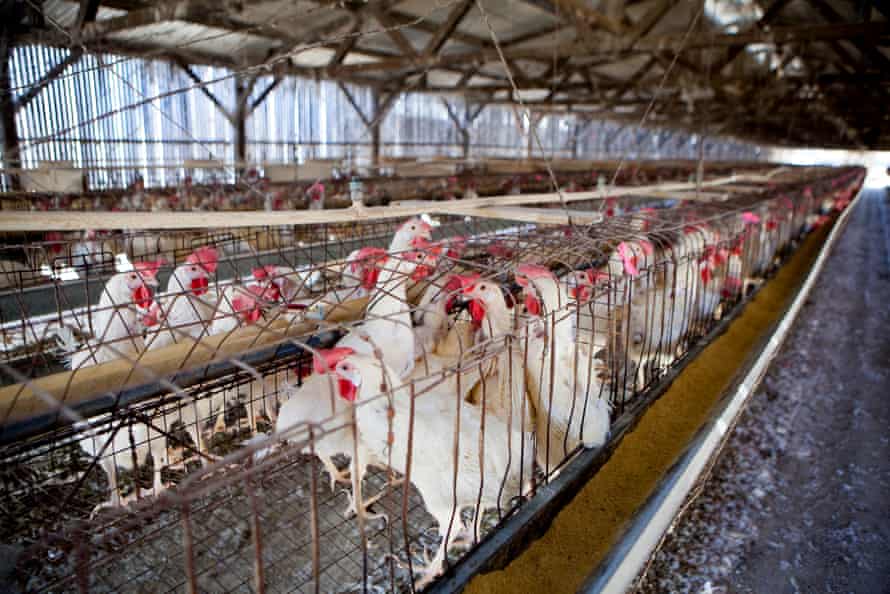
Instead, antibiotics are given to make nutrient animals put on weight more quickly than they would otherwise, or to protect food animals from illnesses that the crowded weather condition of livestock production make them vulnerable to. And most two-thirds of the antibiotics that are used for those purposes are compounds that are too used against human being illness – which means that when resistance against the farm use of those drugs arises, it undermines the drugs' usefulness in human medicine too.
Resistance is a defensive adaptation, an evolutionary strategy that allows bacteria to protect themselves against antibiotics' power to kill them. Information technology is created by subtle genetic changes that allow organisms to counter antibiotics' attacks on them, altering their cell walls to keep drug molecules from attaching or penetrating, or forming tiny pumps that squirt the drugs after they have entered the cell.
What slows the emergence of resistance is using an antibody conservatively: at the correct dose, for the right length of time, for an organism that will be vulnerable to the drug, and not for any other reason. Most antibiotic use in agriculture violates those rules.
Resistant bacteria are the result.
* * *
Antibiotic resistance is similar climate change: it is an overwhelming threat, created over decades by millions of private decisions and reinforced by the deportment of industries.
It is also like climate change in that the industrialized westward and the emerging economies of the global south are at odds. One quadrant of the globe already enjoyed the cheap poly peptide of factory farming and at present regrets it; the other would like not to forgo its chance. And information technology is additionally similar climate modify because any activity taken in hopes of ameliorating the problem feels inadequate, like buying a fluorescent lightbulb while watching a polar acquit drown.
But that it seems difficult does not mean information technology is non possible. The willingness to relinquish antibiotics of farmers in the Netherlands, every bit well as Perdue Farms and other companies in the United States, proves that industrial-scale product tin can be achieved without growth promoters or preventive antibiotic use. The stability of Maïsadour and Loué and White Oak Pastures shows that medium-sized and small farms can secure a identify in a remixed meat economy.
Whole Foods' pivot to slower-growing chicken – birds that share some of the genetics preserved by Frank Reese – illustrates that removing antibiotics and choosing birds that do not need them returns biodiversity to poultry product. All of those achievements are signposts, pointing to where chicken, and cattle and hogs and farmed fish subsequently them, demand to get: to a mode of production where antibiotics are used equally infrequently as possible – to intendance for sick animals, merely not to fatten or protect them.
That is the way antibiotics are now used in human being medicine, and it is the only way that the utility of antibiotics and the risk of resistance can be adequately balanced.
Excerpted from Big Craven by Maryn McKenna published by National Geographic on 12 September 2017. Available wherever books are sold.
Plucked! The Truth About Chicken past Maryn McKenna is published in the UK by Little, Brownish and is now available in eBook @£14.99, and is published in Trade Format @£14.99 on one February 2018.
Source: https://www.theguardian.com/lifeandstyle/2017/oct/13/can-never-eat-chicken-again-antibiotic-resistance
0 Response to "If You Read This You May Never Eat Chicken Again"
Post a Comment