what happened to the space shuttle challenger in 1986 essay
Infinite shuttle Challenger and the disaster that changed NASA forever
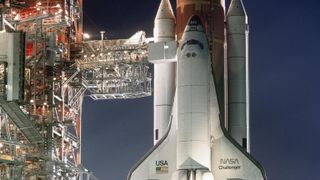
The infinite shuttle Challenger — during its 10th launch – on January. 28, 1986, exploded 73 seconds subsequently liftoff, killing all seven crewmembers and changing NASA's space program forever.
Challenger was the second shuttle to achieve space, in Apr 1983. It successfully completed nine milestone missions during nearly three years of service. In total, the spacecraft spent 62 days, vii hours, 56 minutes and 22 seconds in space, according to CBS (opens in new tab).
Challenger hosted the first spacewalk of the space shuttle programme on April seven, 1983, and carried the first American female person and first black astronauts.
More: Remembering Challenger: NASA'southward 1st Shuttle Tragedy in Photos
From test vehicle to infinite vehicle
NASA originally intended Challenger to be a test vehicle, according to the Kennedy Space Center (opens in new tab). Rockwell International, an aerospace manufacturing company, began edifice the shuttle in Nov 1975 and and then sent it to Lockheed Martin (opens in new tab), another aerospace engineering science company, for structural testing starting on April 2, 1978, according to Reference for Business (opens in new tab), an educational business concern site. According to a statement by NASA, computer models at the time were not sophisticated plenty to calculate the stresses on the shuttle during dissimilar phases of flight.
Space Shuttle Challenger: Key facts
First Flight: April 4-9, 1983
Concluding Flight: January 28, 1986
Number of Missions: ten
Fourth dimension in Space: 1,496 Hours
The shuttle, and then known as STA-099, went through xi months of vibration testing in a specially formulated rig, NASA said (opens in new tab). This custom-designed machine could bring the shuttle through a simulation of all phases of flying, from liftoff to landing. Three hydraulic cylinders, each with 1 meg lbs. of strength, were used as substitute space shuttle main engines.
In 1979, NASA awarded Rockwell International a supplemental contract to convert the test vehicle to a spacecraft. This would aggrandize the shuttle fleet to ii spacecraft, with Columbia being the kickoff, though this would similarly finish in disaster.
It took 2 more years for Rockwell to perform the conversion. Among other things, workers had to strengthen the wings, put in a real crew cabin instead of a simulated 1 and install heads-upward displays for the astronauts working inside. Piece of work was completed on October. 23, 1981, according to NASA (opens in new tab).
Delays for the commencement flight
Challenger was expected to go into space on Jan. xx, 1983, to release the first Tracking and Data Relay Satellite (TDRS), which later became part of a series of satellites that astronauts used to stay in touch on with controllers dorsum home. But several technical malfunctions pushed the launch back.
First, NASA discovered a hydrogen leak in the No. ane main engine aft compartment during a flight readiness test in December, co-ordinate to Science.ksc (opens in new tab). In a second test on Jan. 25, 1983, NASA discovered cracks in the engine that were causing the leak.
The agency then took several months to remove the engines and examination them. While engines No. 2 and No. three were deemed healthy, NASA replaced engine No. 1, co-ordinate to The New York Times.
After some other delay due to a problem with the TDRS, Challenger launched successfully on April 4, 1983, on mission STS-vi. Crewmembers ready the satellite complimentary. Astronauts Story Musgrave and Donald Peterson executed the first spacewalk of the shuttle program.
Cultural and technical firsts
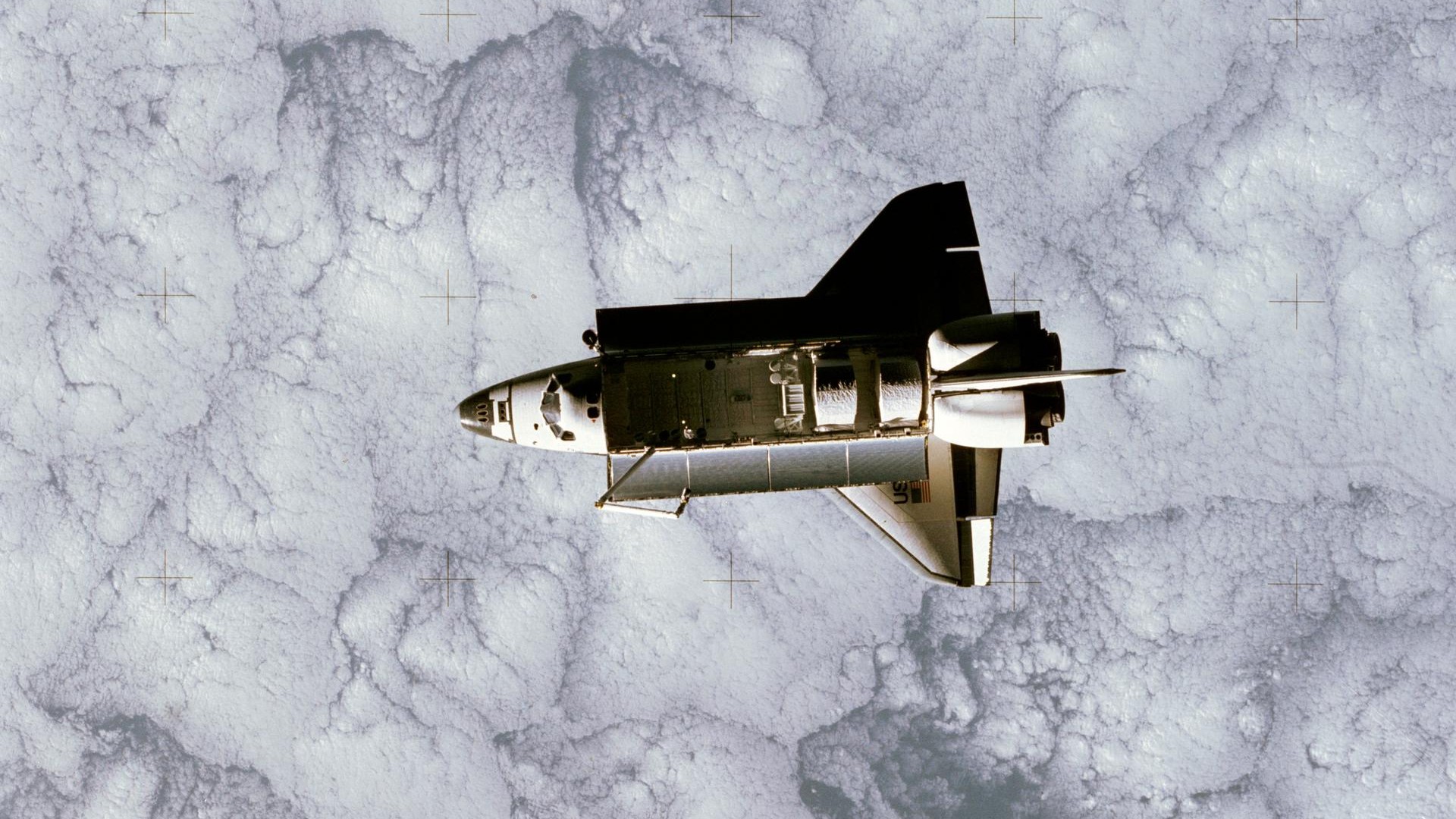
In improver to milestones in space applied science, Challenger was also host to several cultural firsts in the space shuttle programme. The outset American female person astronaut, Sally Ride, rode up on Challenger on STS-7 in June 1983. The beginning black astronaut, Guion Bluford, reached space on STS-viii.
On STS-41G in 1984, 2 women — Ride and Kathryn Sullivan — flew on i mission for the beginning time — as well as the first Canadian, Marc Garneau.
Challenger reached other milestones, too, including the first nighttime launch and landing (STS-8) and the get-go operational Spacelab flight (STS-51B). Spacelab was a European space laboratory that fit into a shuttle's cargo bay and included several experiments designed for tests in microgravity. It flew on Columbia on STS-nine for the showtime time, but Challenger's mission is considered the showtime working one.
The flying repairman
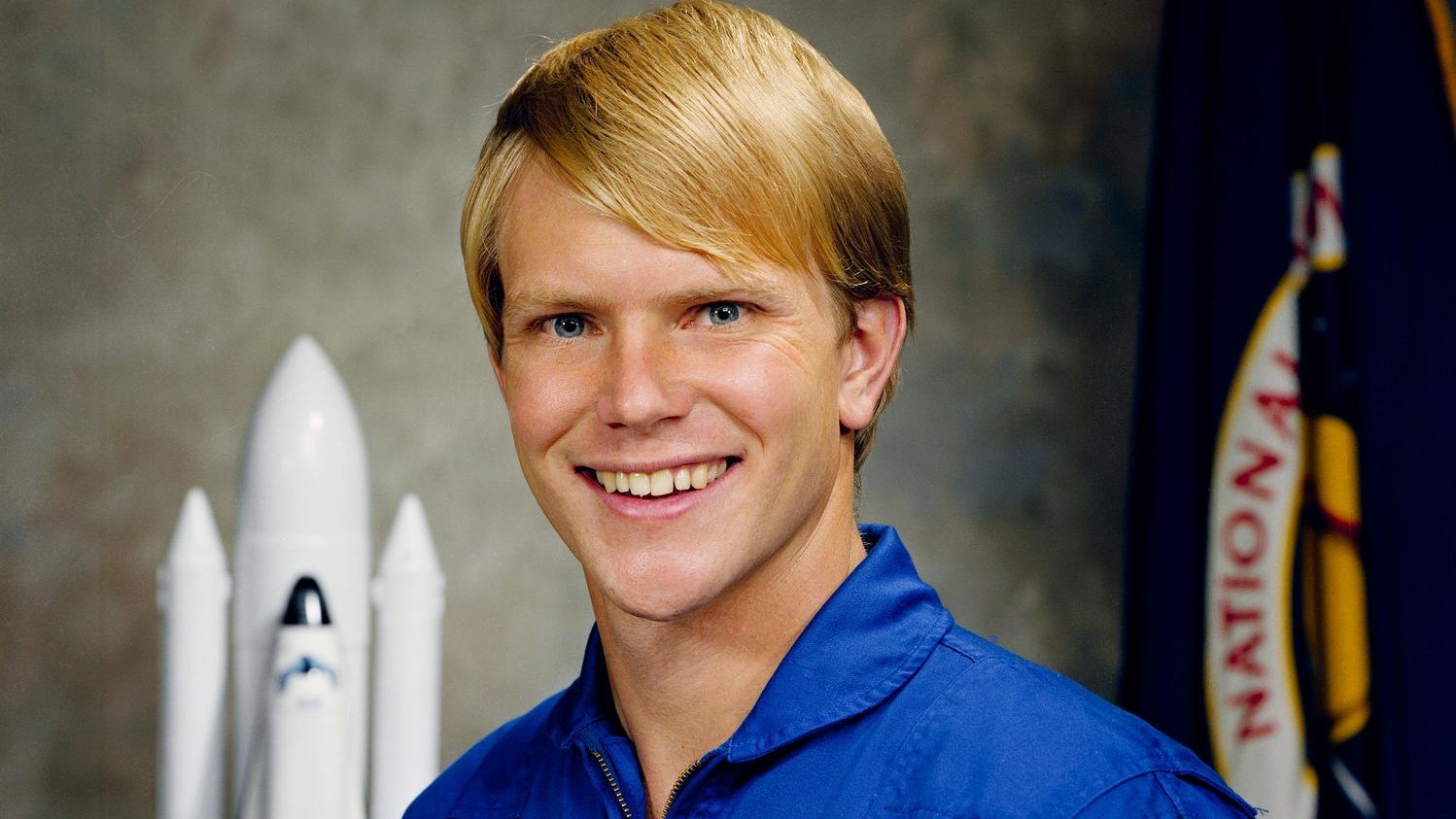
Some of Challenger's virtually memorable moments took place in April 1984, on STS-41C. That mission featured the very first astronaut repair of a satellite.
To get at the nonfunctional Solar Maximum Mission (SMM) satellite, astronaut George Nelson strapped himself into the Manned Maneuvering Unit, which was a jet-powered backpack designed for astronauts to wing in space. It had been tested on only one mission before this one.
The coiffure maneuvered Challenger until information technology was only 200 feet from the satellite, according to the Life Sciences Data Archive (opens in new tab). Then, Nelson carefully left the prophylactic of the shuttle and flew over to the satellite. A fixture on the forepart of his backpack permit Nelson dock with the satellite, which was slowly tumbling in infinite, according to an commodity by NASA (opens in new tab).
Side by side, he fired the jets on his haversack to stop the satellite'due south spin. Crewmembers on Challenger then reached out with the shuttle'due south Canadarm robotic arm and plucked the satellite out of empty infinite and into the payload bay.
Nelson and crewmate James "Ox" Van Hoften repaired the satellite, then the crew lofted the satellite dorsum into space, according to The New York Times (opens in new tab). SMM connected operation for several years, and then burned upwardly in the atmosphere in December 1989.
Challenger disaster
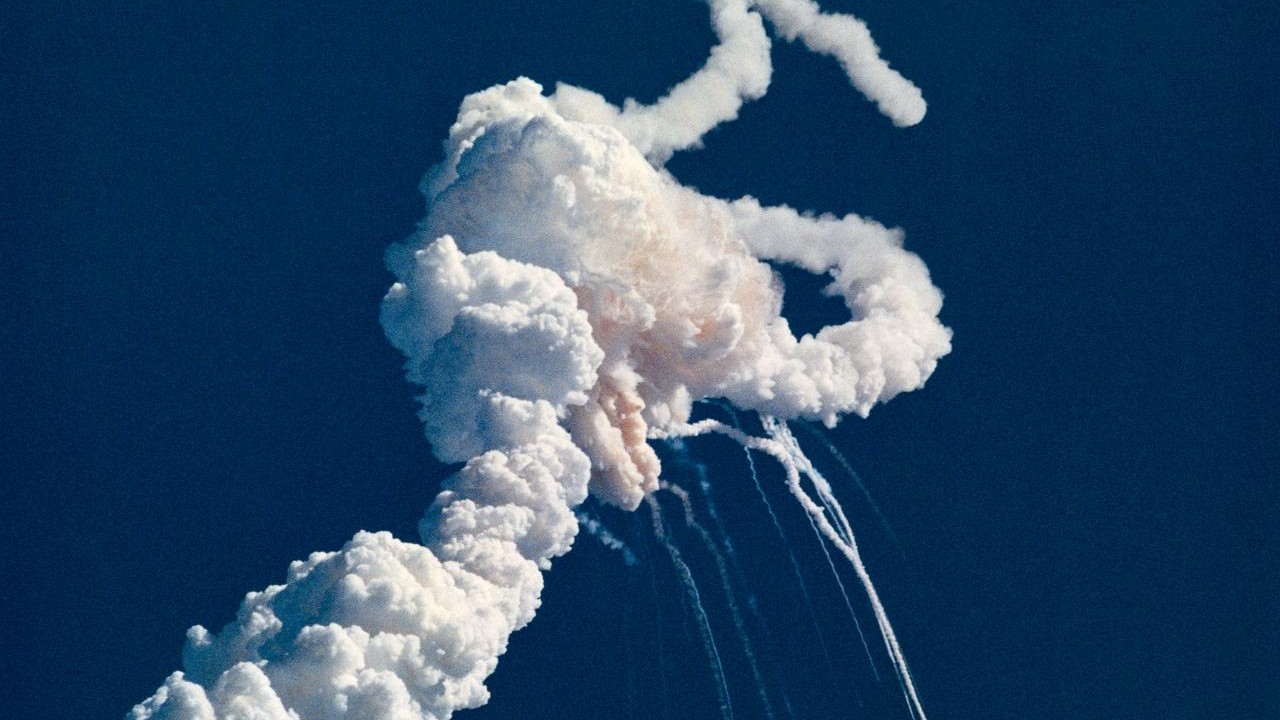
Information technology was a common cold morning time on Jan. 28, 1986, when Challenger was scheduled to fly its 10th mission, according to Atmospheric condition.com (opens in new tab). Temperatures dipped below freezing and some of the shuttle'due south engineers were concerned nearly the integrity of the seals on the solid rocket boosters in such low temperatures.
Nonetheless, Challenger launched at 11:38 a.grand. Eastern time in forepart of more than media attention than usual, since it was carrying the first teacher to go into infinite, NASA (opens in new tab) said. Christa McAuliffe was planning to give lessons while in orbit.
But McAuliffe and the remainder of the crew never fabricated it. In full view of the goggle box cameras, Challenger bankrupt up 73 seconds afterwards launch.
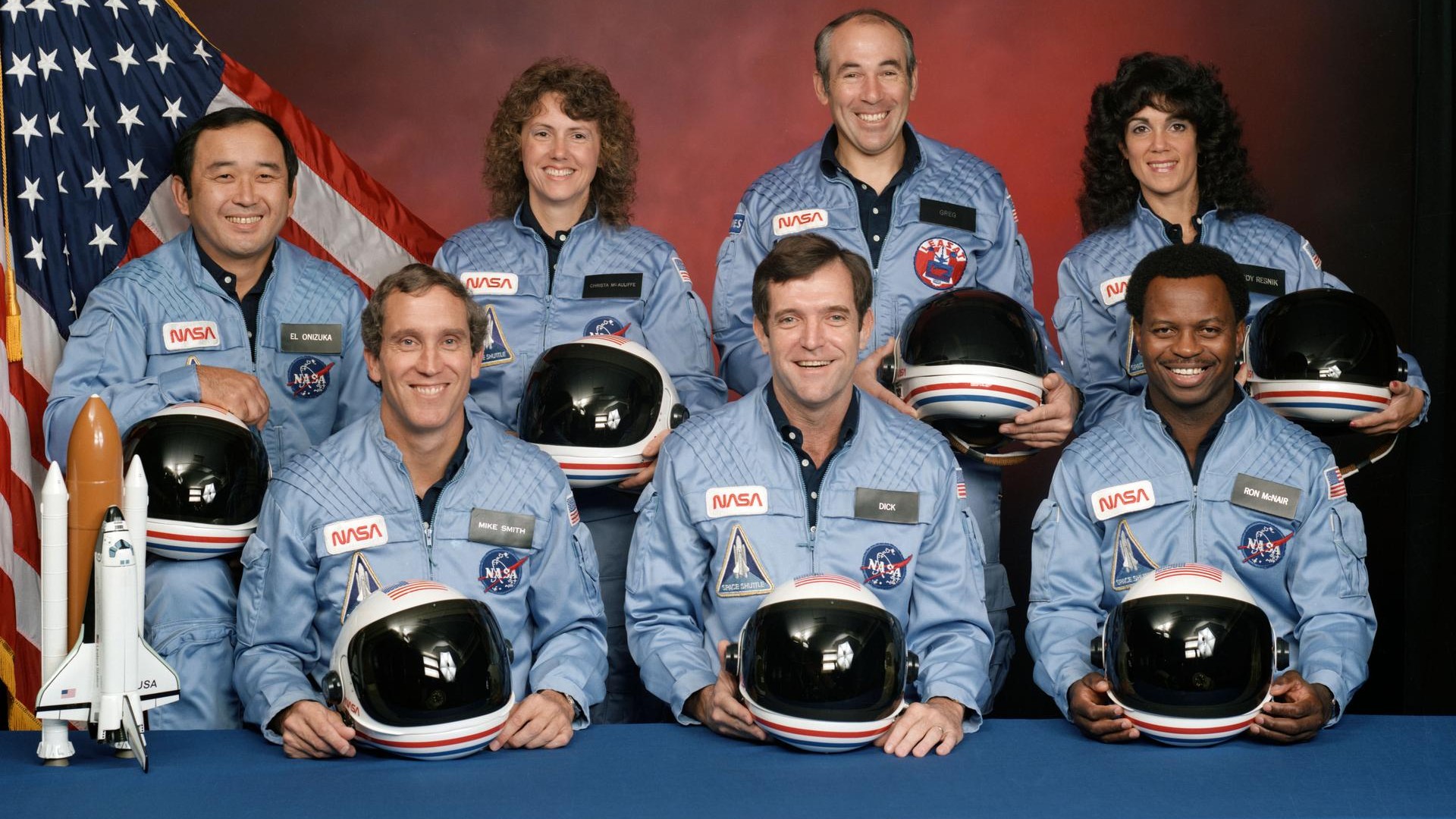
Infinite Shuttle Challenger concluding crew
Mission Commander: Francis Scobee
Pilot: Michael Smith
Mission Specialist: Judith Resnik
Mission Specialist: Ronald McNair
Mission Specialist: Ellison Onizuka
Payload Specialist: Gregory Jarvis
Payload Specialist, Instructor: Christina McAuliffe
"Flight controllers here are looking very carefully at the situation. Obviously a major malfunction," the NASA launch commentator said (opens in new tab), as pieces of the shuttle vicious from the sky into the Atlantic.
Salvage crews spent several weeks recovering pieces of the shuttle and carefully bringing up the remains of the seven astronauts. Remains that could be identified were turned over to the families, while the rest were buried in a monument to the Challenger crew at Arlington National Cemetery on May xx, 1986, according to Arlington'due south official site (opens in new tab).
Culture of work and technical bug at NASA
The commission report talked about the technical causes of the accident. The entire failure could be traced to an O-band, a safe seal on the solid rocket boosters (co-ordinate to Nasa Technical Reports Server (opens in new tab)) that degraded in the cold conditions of the launch.
Read more: The Space Shuttle Challenger Disaster: What Happened? (Infographic)
But the O-ring would non accept been a problem had NASA not chosen to launch on so common cold a day –— the coldest launch yet, co-ordinate to an NPR interview (opens in new tab) with ane of the shuttle engineers. While the engineer blames himself for non convincing NASA and high-level managers of the danger the cold presented, a US Firm of Representatives report from the Committee on Scientific discipline and Technology (opens in new tab) concluded that it was a long-standing failure in safety protocols, combined with an unsustainable launch charge per unit that led to the disaster.
In the wake of what happened with Challenger, NASA made technical changes to the shuttle and as well worked to change the safety and accountability culture of its workforce. The shuttle plan resumed flights in 1988, co-ordinate to a piece by NASA.
After the Challenger wreckage was examined, near of the pieces were buried and sealed in abased Minuteman missile silos at Cape Canaveral Air Force Station (opens in new tab), where they remain today.
Challenger'due south explosion changed the space shuttle programme in several ways. Plans to wing civilians in infinite (such every bit teachers or journalists) were shelved for the next 22 years, co-ordinate to The Smithsonian Magazine (opens in new tab). Information technology would not be until 2007 that Barbara Morgan, who was McAuliffe'due south backup, flew aboard Effort. Satellite launches were shifted from the shuttle to reusable rockets. Additionally, astronauts were pulled off duties such as repairing satellites, and the Manned Maneuvering Unit was not flown once again, to better preserve astronaut prophylactic.
Every January, NASA pauses to call up the last crew of Challenger and the other crews lost in pursuing space, on a NASA Day of Remembrance.
Challenger has also left an educational legacy: Members of the crews' families founded the Challenger Center for Space Science Pedagogy program (opens in new tab), which brings students on simulated space missions.
Visitors to the Kennedy Infinite Center (opens in new tab) can view droppings from Challenger'due south last mission (too equally Columbia) at an showroom called "Forever Remembered, (opens in new tab)" which opened in 2015. The debris are on display at the company's center.
Additional Resources
To notice how the grief acquired by the disaster helped inspire teachers and students, check out this Space.com article: 25 Years After Challenger: How Grief Inspired Teachers and Students. Or you lot can Listen to how 30 Years After Explosion, Challenger Engineer Yet Blames Himself (opens in new tab), from NPR. If you are interested, you can read more about NASA'southward space shuttle plan.
Bibliography
- CBS News Space Calculator (opens in new tab)
- Space Shuttle Overview: NASA (opens in new tab)
- Rockwell International Cooperation: Reference for Business (opens in new tab)
- Challenger - Science. KSC (opens in new tab)
- "Challenger'south flight is Delayed Again", New York Times, March 1 1983
- Emilie Le Beau Lucchesi, "A Expect Dorsum At The Challenger Disaster (opens in new tab)", Astronomy.com, October 25th 2021
- Life Sciences Data Archive (opens in new tab)
- O-Ring, Nasa Technical Reports Server (opens in new tab)
- Greg Daugherty, "The Challenger Disaster Put and End to NASA's Plans to ship Civillian'due south Into Infinite (opens in new tab)", Smithsonian Magazine, January 27th 2016
Bring together our Infinite Forums to keep talking space on the latest missions, night sky and more! And if y'all have a news tip, correction or comment, let u.s. know at: community@space.com.
Join our Infinite Forums to keep talking space on the latest missions, night sky and more! And if you have a news tip, correction or annotate, permit us know at: community@infinite.com.

Elizabeth Howell, Ph.D., is a contributing writer for Space.com (opens in new tab) since 2012. Every bit a proud Trekkie and Canadian, she tackles topics like spaceflight, diversity, science fiction, astronomy and gaming to help others explore the universe. Elizabeth's on-site reporting includes ii human spaceflight launches from Republic of kazakhstan, and embedded reporting from a false Mars mission in Utah. She holds a Ph.D. and M.Sc (opens in new tab). in Space Studies from the Academy of N Dakota, and a Bachelor of Journalism from Canada's Carleton University. Her latest volume, NASA Leadership Moments, is co-written with astronaut Dave Williams. Elizabeth starting time got interested in space later on watching the picture Apollo thirteen in 1996, and nonetheless wants to be an astronaut someday.
Source: https://www.space.com/18084-space-shuttle-challenger.html
0 Response to "what happened to the space shuttle challenger in 1986 essay"
Post a Comment