what percentage of rapes is reported to the police?
Rape in the United States is divers past the Department of Justice as "Penetration, no affair how slight, of the vagina or anus with any body function or object, or oral penetration by a sex organ of another person, without the consent of the victim." While definitions and terminology of rape vary by jurisdiction in the United States, the FBI revised its definition to eliminate a requirement that the crime involve an element of force.[ane]
A 2013 written report constitute that rape may be grossly underreported in the U.s.a..[two] Furthermore, a 2014 study suggested that police departments may eliminate or undercount rapes from official records in function to "create the illusion of success in fighting violent offense".[3] For the last reported twelvemonth, 2013, the almanac prevalence rate for all sexual assaults including rape was 0.1% (annual prevalence rate represents the number of victims each year, rather than the number of assaults since some are victimized more than in one case during the reporting period). The survey included males and females aged 12+.[4] Since rapes are a subset of all sexual assaults, the prevalence of rape is lower than the combined statistic.[5] Of those assaults, the Bureau of Justice Statistics stated that 34.8% were reported to the police, upward from 29.3% in 2004.[vi]
Definitions [edit]
In the United States, at the Federal level, the FBI'southward Uniform Offense Report (UCR) definitions are used when collating national crime statistics from states across the The states. The UCR's definition of rape was inverse on 1 January 2013 to remove the requirement of forcefulness against a female person and to include a wider range of types of penetration.[1] The new definition reads:
Penetration, no matter how slight, of the vagina or anus with any body part or object, or oral penetration past a sex organ of another person, without the consent of the victim.
For 80 years prior to the 2013 change, the UCR's definition of rape was "lecherous knowledge of a female forcibly and confronting her will".[7]
At the state level, in that location is no uniform legal definition of rape ; instead, each state has their ain laws. These definitions can vary considerably, but many of them do not use the term rape anymore, instead using sexual set on, criminal sexual bear, sexual abuse, sexual battery, etc.
One legal definition, which is used past the U.s. War machine is found in the United States Uniform Code of Military Justice [Title ten, Subtitle A, Chapter 47X, Section 920, Article 120], defines rape as:
(a) Rape. — Any person bailiwick to this chapter who commits a sexual act upon another person by —
(ane) using unlawful force against that other person;
(2) using force causing or likely to crusade death or grievous bodily harm to any person;
(3) threatening or placing that other person in fright that whatsoever person will exist subjected to death, grievous bodily impairment, or kidnapping;
(4) first rendering that other person unconscious; or
(5) administering to that other person past force or threat of force, or without the knowledge or consent of that person, a drug, intoxicant, or other like substance and thereby substantially impairing the power of that other person to appraise or control conduct;
is guilty of rape and shall be punished as a court-martial may direct.[8]
Statistics and data [edit]
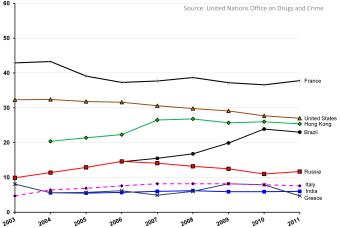
Almanac rape and all forms of sexual assaults per 100,000 people, in diverse countries, 2003–2011.
Prevalence and number of incidents [edit]
Rape prevalence amongst women in the U.Southward. (the pct of women who experienced rape at least one time in their lifetime then far) is in the range of 15–20% according to different studies (National Violence confronting Women survey, 1995, found 17.vi% prevalence rate;[9] a 2007 national study for the Department of Justice on rape plant xviii% prevalence charge per unit.[ten]). According to a March 2013 report from the U.Southward. Department of Justice's Agency of Justice Statistics, from 1995 to 2010, the estimated annual charge per unit of female rape or sexual set on declined 58%, from 5.0 victimizations per 1,000 females historic period 12 or older to 2.1 per 1,000. Assaults on young women aged 12–17 declined from 11.three per 1,000 in 1994–1998 to 4.1 per ane,000 in 2005–2010; assaults on women aged 18–34 besides declined over the same menstruum, from seven.0 per 1,000 to 3.7.[eleven] [12]
The 2018 Uniform Crime Report (UCR), which measures rapes that are known to constabulary, estimated that in that location were 127,258 rapes reported to police enforcement in 2018.[xiii] The 2016 National Criminal offence Victimization Survey (NCVS), which measures sexual assaults and rapes that may not have been reported to the police, estimated that in that location were 431,840 incidents of rape or sexual assault in 2015.[fourteen]
Other government surveys, such as the Sexual Victimization of College Women study, critique the NCVS on the basis it includes just those acts perceived as crimes by the victim, and report a much higher victimization charge per unit.[15] Estimates from other sources typically written report much higher levels of both rape and sexual assault than either the NCVS or UCR. A 2010 study conducted by the Centers for Disease Command found that around 1 in 5 women and 1 in 71 men(an additional 1 in 21 men were 'made to penetrate' someone else) had experienced an attempted or completed rape in their lifetime.[sixteen] [17] Differences in survey samples, definitions of rape and sexual assault, and the wording of survey questions likely contribute to these differences, and there is no consensus on the best way to measure rape and sexual assault. Both the NCVS and UCR are believed to significantly under-count the number of rapes and sexual assaults that occur.[18]
Based on the available data, 21.eight% of American rapes of female victims are gang rapes.[19]
Shift in the form of crime [edit]
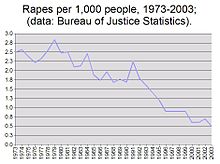
Over the last four decades, rape has been declining. According to the National Crime Victimization Survey, the adjusted annual per-capita victimization rate of rape has declined from about 2.four per 1000 people (age 12 and in a higher place) in 1980 (that is, ii.4 persons from each 1000 people 12 and older were raped in 1980) to about 0.4 per thousand people in 2003, a reject of virtually 85%. There are several possible explanations for this, including stricter laws and teaching on security for women.[ commendation needed ]
Demographics of attackers and victims [edit]
The Federal Bureau of Investigation have also nerveless data cases involving victims and perpetrators of sex offenses:
| Year | Offenders | Victims | ||||
|---|---|---|---|---|---|---|
| Male | Female person | Unknown | Male | Female | Unknown | |
| 2012[xx] [21] | 65,071 (Forcible) v,859 (Nonforcible) | three,853 (Forcible) 541 (Nonforcible) | 1,517 (Forcible) 86 (Nonforcible) | 11,471 (Forcible) 629 (Nonforcible) | 61,486 (Forcible) 5,859 (Nonforcible) | 175 (Forcible) 5 (Nonforcible) |
| 2013[22] [23] | 62,280 (Forcible) 5,396 (Nonforcible) | iii,846 (Forcible) 530 (Nonforcible) | 1,486 (Forcible) 77 (Nonforcible) | 10,961 (Forcible) 643 (Nonforcible) | 58,981 (Forcible) 5,511 (Nonforcible) | 202 (Forcible) 9 (Nonforcible) |
| 2014[24] [25] | 62,393 (Forcible) 4,804 (Nonforcible) | 4,034 (Forcible) 498 (Nonforcible) | 1,678 (Forcible) 51 (Nonforcible) | 10,821 (Forcible) 590 (Nonforcible) | 59,875 (Forcible) four,888 (Nonforcible) | 232 (Forcible) six (Nonforcible) |
| 2015[26] [27] | 66,545 (Forcible) 4,712 (Nonforcible) | 4,391 (Forcible) 473 (Nonforcible) | 2,069 (Forcible) 52 (Nonforcible) | xi,463 (Forcible) 520 (Nonforcible) | 64,202 (Forcible) four,836 (Nonforcible) | 225 (Forcible) 3 (Nonforcible) |
| 2016[28] [29] | 73,249 (Forcible) 4,588 (Nonforcible) | 4,580 (Forcible) 516 (Nonforcible) | 2,174 (Forcible) 74 (Nonforcible) | 12,146 (Forcible) 637 (Nonforcible) | 71,180 (Forcible) 4,723 (Nonforcible) | 285 (Forcible) 6 (Nonforcible) |
| 2017[30] [31] | 79,635 (Forcible) 4,859 (Nonforcible) | 4,887 (Forcible) 516 (Nonforcible) | 2,448 (Forcible) 69 (Nonforcible) | 12,632 (Forcible) 682 (Nonforcible) | 78,308 (Forcible) 4,922 (Nonforcible) | 268 (Forcible) nine (Nonforcible) |
| 2018[32] [33] | 91,838 | 6,002 | iii,024 | 14,365 | 91,219 | 324 |
| 2019[34] [35] | 105,030 | 6,920 | 3,230 | sixteen,263 | 104,720 | 348 |
Most rape research and reporting to date has concentrated on male-female forms of rape. Male-male person and female-male rape has not been as thoroughly researched, and most no enquiry has been done on female-female rape.
A 1997 written report by the U.S. Agency of Justice Statistics plant that 91% of rape victims are female and 9% are male, and that 99% of arrestees for rape are male person.[36] : ten Still, these statistics are based on reports of "forced penetration". This number excludes instances where men were "made to penetrate" another person, which are assessed separately under "sexual violence". Denov (2004) states that societal responses to the upshot of female person perpetrators of sexual attack "point to a widespread deprival of women as potential sexual aggressors that could work to obscure the true dimensions of the trouble."[37]
A 2014 study by the Bureau of Justice Statistics of college campus rape statistics from National Crime Victimization Survey data collected from 1995 to 2013, and show that rape in college are independent of race.[38] The National Violence Confronting Women Survey found that 34% of American Indian female respondents had experienced attempted or completed rape in their lifetime. The rapist was more likely to exist a non-Native than a Native.[39]
The 2010 National Intimate Partner and Sexual Violence Survey found that thirteen.i% of lesbians, 46.i% of bisexual women, and 17.4% of heterosexual women accept been raped, physically assaulted, or stalked.[40]
Relationship between assailant and victim [edit]
An examination of the relationships between the victim and their attacker indicates the following:
| Relationship of victim to rapist before the incident[41] | |
|---|---|
| Current or former intimate partner | 26% |
| Some other relative | 7% |
| Friend or acquaintance | 38% |
| Stranger | 26% |
About four out of x sexual assaults take place at the victim's own habitation.[36] : 3
U.S. Senator Martha McSally, an Arizona Republican, said during a Senate coming together on sexual assail in the military machine that she was raped past a superior officer in the U.S. Air Forcefulness. McSally was the first female combat pilot in the U.S. Air Force. She said that she never reported information technology because so many people didn't trust the system, she blamed herself, she was ashamed and dislocated, and she thought she was strong but was made to feel powerless.[42]
Underreporting [edit]
A 2014 report by the Department of Justice estimated that 34.eight% of cases of sexual assaults are reported to the government.[6]
When sufficient Deoxyribonucleic acid or injury evidence was procured from a adult female'due south trunk, she was more likely to follow through with the legal process of prosecution as there was more conviction in a favorable upshot for her. Women who experienced forced sexual attack more frequently were less likely to follow through with the legal process than women who practice not feel forced sexual assail frequently.[43]
| Reasons victims reported sexual violence to constabulary enforcement (2005-2010)[44] | |
|---|---|
| 28% | Protect household or victim from further crimes past the offender |
| 25% | Stop an ongoing incident or prevent immediate recurrence or escalation |
| 21% | Felt a duty to study or to improve police force surveillance |
| 17% | Take hold of or punish offender, prevent crimes against others |
| ix% | Other or multiple reasons |
| Reasons victims did not study sexual violence to law enforcement (2005-2010)[44] | |
|---|---|
| 20% | Feared retaliation |
| 13% | Believed the police would not do anything to assist |
| xiii% | Believed information technology was a personal matter |
| 8% | Reported to non-constabulary-enforcement official |
| 8% | Believed it was not important enough to report |
| 7% | Did not want to become the perpetrator in trouble |
| 2% | Believed the police force could not exercise anything to help |
| thirty% | Other or multiple reasons |
Prosecution charge per unit [edit]
According to FBI statistics, out of 127,258 rapes reported to police departments in 2018, 33.4 percent resulted in an arrest.[13] Based on correlating multiple data sources, RAINN (Rape, Abuse, and Incest National Network) estimates[44] that for every 1,000 rapes, 384 are reported to police, 57 result in an arrest, 11 are referred for prosecution, 7 effect in a felony conviction, and vi result in incarceration. This compares to a higher charge per unit at every stage for similar crimes.
College and university campuses [edit]
Definitions of rape tin can vary, and since non all rapes are reported, researchers instead rely on surveys of pupil and nonstudent populations to develop a more comprehensive understanding of the prevalence. Survey blueprint including the questions and the sample quality and telescopic can as well create broad ranges in rates. Research estimates anywhere from approximately 10%[45] to 29%[46] of women accept been victims of rape or attempted rape since starting college. Methodological differences, such as the method of survey assistants, the definition of rape or sexual assail used, the wording of questions, and the time period studied contribute to these disparities.[46]
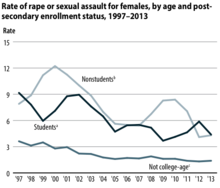
Rape, a subset of sexual assault, took identify 3.ane times per ane,000 in females aged xviii to 24 in the year 2013[five]
One recent analysis, conducted by U.S. Department of Justice's Bureau of Justice Statistics, represents a longitudinal study of US women from 1995 to 2013. For the year 2013, the report institute that there were more incidents of rape victimization amongst women aged eighteen–24 (4.3 per ane,000), compared to women outside that age range (one.4 per 1,000).[5]
In an effort to prevent rape on campuses, the Obama administration instituted policies requiring schools to investigate rape cases and adjudicate rape cases under a "preponderance of the evidence" standard.[47] These policies accept been sharply criticized by civil libertarians concerned that they are eroding due process and will atomic number 82 to wrongful convictions of the innocent.[48] [49] [50] [51] [52] [53] A number of lawsuits have been filed against colleges and universities by students claiming to have been wrongfully expelled for rape they did not commit.[54] [55] [56] In 2016 the colleges with the highest rapes included Brown University and UConn tying for 43 rapes a year. Followed by Dartmouth College with 42, Wesleyan University with 35, University of Virginia with 35, Harvard with 33, University of NC at Charlotte with 32, Rutgers in New Brunswick with 32, University of Vermont with 27 and ending with Stanford with 26 rapes per year.[57]
Prevention programs vary across college campuses. Norms-based programs to inform students that they are non alone in knowledge of rape victims and perpetrators may encourage students to view sexual assail as a larger problem in their community.[58] Additionally, artistic campaigns on higher campuses that market consent were found to be effective in raising awareness of campus sexual assaults and issues related to this trouble.[59]
Number of incidents [edit]
| Rape or sexual attack victimization confronting females ages eighteen to 24, by post-secondary enrollment status, 1995–2013[60] | ||
|---|---|---|
| Categories | Student victim | Non-student victims |
| Total | 31,302 | 65,668 |
| Completed rape | 10,237 | 26,369 |
| Attempted rape | 7,864 | fifteen,792 |
| Sexual assail | 9,714 | 18,260 |
| Threat of rape or sexual assault | 3,488 | five,247 |
The mean annual population was 5,130,004 for students and 8,614,853 for non-students.[60]
Criminal penalty [edit]

Compulsion-based law (all penetrative sex)
Consent-based law (anal and oral sex)
Consent-based police (vaginal, anal and oral sex)
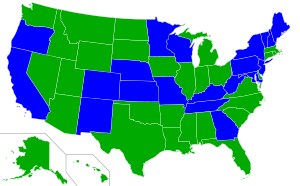
Coercion-based law (non-penetrative sex)
Consent-based police force (non-penetrative sex)
The United States is equanimous principally of fifty states, each with its own criminal code,[61] as well equally the federal jurisdiction. Rape is prosecutable in all U.Southward. jurisdictions,[61] [62] likewise as under the Uniform Code of Military machine Justice,[63] [64] although the terminology used varies by jurisdiction. Amidst the alternate names that may be used to prosecute a rape charge, the crime may exist categorized as sexual assault, sexual battery, or criminal sexual bear.[65]
Some U.S. states (or other jurisdictions such as American Samoa) recognize penetrative sex activity without consent past the victim and without the employ of forcefulness past the perpetrator as a criminal offense (ordinarily chosen 'rape'). Other states do not recognize this as a crime; their laws stipulate that the perpetrator must have used some kind of forcefulness or coercion (physical violence (that results in demonstrable physical injury), threats against the victim or a third party, or another grade of coercion) in order for such nonconsensual penetrative sexual practice to amount to a crime.[66] Similarly, some states (or other jurisdictions such as the Armed forces) recognize non-penetrative sex acts (contact such as fondling or touching a person'due south intimate parts, or exposure of a body or sex) without consent past the victim and without the use of strength by the perpetrator as a crime, while other states do not.[66]
Jurisdiction [edit]
In the United States, the principle of dual sovereignty applies to rape, equally to other crimes. If the rape is committed within the borders of a state, that country has jurisdiction. If the victim is a federal official, an ambassador, delegate, or other foreign official under the protection of the U.s.a., or if the law-breaking took place on federal belongings or involved crossing state borders, or in a fashion that substantially affects interstate commerce or national security, then the federal government likewise has jurisdiction.
If a crime is non committed inside any land, such equally in the Commune of Columbia or on a naval or U.South.-flagged merchant vessel in international waters, then federal jurisdiction is sectional. In cases where the rape involves both state and federal jurisdictions, the offender can be tried and punished separately for each law-breaking without raising bug of double jeopardy. When a land has jurisdiction over a rape case, as a affair of policy, federal prosecution volition not be pursued for a rape accuse unless the case presents a thing of federal involvement, that interest was not fairly addressed by a state-level prosecution, and the government believes that a federal prosecution will be successful.[67]
Jurisdiction issues also complicate the handling of campus rape, due in office to overlapping jurisdiction of campus and local constabulary enforcement, and differences in how various police agencies and prosecutors handle sex offenses.[68]
Federal law [edit]
Federal law does not utilise the term "rape". Rape is grouped with all forms of non-consensual sexual acts under chapter 109a of the United States Code (18 U.s.C. §§ 2241–2248).
Under federal law, the punishment for rape can range from a fine to life imprisonment. The severity of the penalisation is based on the use of violence, the age of the victim, and whether drugs or intoxicants were used to override consent. If the perpetrator is a echo offender the law prescribes automatically doubling the maximum judgement.
Whether the victim is an adult[69] or of a child,[70] the U.S. Supreme Court has held that the death sentence is not available as a possible penalty if the victim does non die and death was not intended by the defendant. Capital punishment remains available equally a penalization where the victim dies, or where the defendant acts with intent to impale the victim but the victim survives.
| Description | Fine | Imprisonment (years) | Life imprisonment |
|---|---|---|---|
| Rape using violence or the threat of violence to override consent | unlimited | 0 – unlimited | yes |
| Rape by causing fearfulness in the victim for themselves or for some other person to override consent | unlimited | 0 – unlimited | yes |
| Rape past giving a drug or intoxicant to a person that renders them unable to requite consent | unlimited | 0–15 | no |
| Statutory rape involving an adult perpetrator | unlimited | 0–15 | no |
| Statutory rape involving an developed perpetrator with a previous conviction | unlimited | 0 – unlimited | yeah |
| Statutory rape involving a perpetrator who is a pocket-sized | unlimited | 0–15 | no |
| When a person causes the rape by a tertiary person | unlimited | 0–10 | no |
| When a person causes the rape of a kid nether 12 past a tertiary person | unlimited | 0 – unlimited | aye |
Investigations [edit]
Medical personnel in the U.s. of America typically collect evidence for potential rape cases unremarkably referred to as rape kits. Though normally collected, the rape kits are non always sent off for testing. Reasons given by the police for rape kits not being tested include cost (processing a kit can price up to $1,500), decisions being made to not prosecute, and victims either recanting or declining to progress the case.[71]
As identifying injury is an important role of identifying rape victims, item attention must be given to examinations of patients with dark skin, particularly the thighs, labia majora, posterior fourchette, and fossa navicularis.[72]
Paper Northern Virginia Sun drew national attending in the belatedly 1970s when owner Herman J. Obermayer said the Dominicus would print the proper name of accusers in rape cases that came to trial, out of a sense of "fairness" between the two sides.[73] Time magazine reported that Obermayer'south policy was "hotly denounced past local feminists, police, prosecutors, hospital officials and nearly all the Sun readers who have written or telephoned Obermayer to comment." Time quoted Benjamin C. Bradlee, executive editor of the Washington Mail service, as saying, "Information technology's wrong. It's misguided. Nosotros wouldn't do it."[73]
Information technology is of import for lawyers selecting jury members to be aware of the stigmas surrounding rape victims and to be able to determine which jurors would be able to come to a guilty verdict according to the law, without being clouded by ane's preconceived ideas of what a "typical" rape victim or perpetrator should look similar.[74]
Treatment of rape victims [edit]
Insurance companies take denied coverage for rape victims, claiming a variety of bases for their actions. One time, later a victim mentioned she had previously been raped 17 years before, an insurance visitor refused to pay for her rape exam and as well refused to pay for therapy or medication for trauma, because she "had been raped before" – indicating a preexisting condition.[75] Some insurance companies have allegedly denied sexual-assault victims mental-health treatment, stating that the service is non medically necessary.[75]
The 2005 Violence Against Women Act requires states to ensure that victims receive access to a forensic examination free of charge regardless of whether the victim chooses to report a sexual set on to constabulary enforcement or cooperate with the criminal-justice system. All states must comply with the VAWA 2005 requirement regarding forensic examination in order to receive STOP Violence Against Women Formula Grant Program (Finish Programme) funds. Under 42 U.South.C. § 3796gg-4, a Country is not entitled to funds under the Cease Program unless the Land or another governmental entity "incurs the total out-of-pocket toll of forensic medical exams ... for victims of sexual assault."[76] This means that, if no other governmental entity or insurance carrier pays for the exam, states are required to pay for forensic exams if they wish to receive End Program funds. The goal of this provision is to ensure that the victim is not required to pay for the exam. The upshot of the VAWA 2005 forensic examination requirement is to let victims time to decide whether to pursue their case. Because a sexual assault is a traumatic event, some victims are unable to make up one's mind whether they desire to cooperate with law enforcement in the immediate backwash of a sexual assault. Because forensic evidence can be lost as fourth dimension progresses, such victims should be encouraged to have the evidence collected as soon as possible without deciding to initiate a written report. This provision ensures victims receive timely medical treatment.[76]
Due to bureaucratic mismanagement in some areas, and various loopholes, the victim is sometimes sent a pecker anyway, and has difficulty in getting it fixed.[77]
Historical context [edit]
Early American history [edit]
During the era of slavery, slave women were frequently sexually driveling and raped by slave owners, the sons of slave owners, and overseers.[78] The sexual abuse of slaves that occurred prior to the Civil War was so prevalent that it strongly influenced the genetic make-up of the overwhelming bulk of African Americans alive today.[79] [80] [81] [82] [83] White men who raped black women were protected by impunity under Southern society, and children of such unions usually inherited the status of their mothers equally slaves. Sexual assaults afflicted girls equally young as 12 years old; a immature slave girl named Celia was the frequent target of her chief, Robert Newsom's abuse. Later having three children with him in a human relationship that began when she was but fourteen, Celia killed her master in self-defense after some other attempt at sexual assault. She was found guilty in court and sentenced to expiry by hanging.[84] Slave women were too field of study to sexual abuse by slave traders and were routinely assaulted on slave ships; the perpetrators faced no legal punishment. The rape of slave women was also done by masters to consequence in a substantial growth of their slaves as holding and increment turn a profit. Slave owners would attempt to justify the abuse of black women during slavery through the stereotype of the Jezebel, a seductive woman who wanted to submit to them.[85] According to authors Judith Worell and Pamela Remer, considering "African American women were sexually exploited during slavery" and because of stereotypes originating from slavery such every bit the Jezebel, blackness women "are non viewed as credible complainants, and are stereotyped (e.k., as promiscuous) in ways that blame them for their rapes."[86]
Before and during the American Civil State of war when slavery was widespread, laws against rape were focused primarily on instances of blackness men raping white women, real or imagined, as opposed to other instances. Black women who were raped by any homo were not protected by the police force.[87] In some states during the 1950s, a white adult female having consensual sex with and a black human was considered rape.[88] and is related to lynchings, racial violence, rapes targeting African-Americans (Such as the Tulsa race massacre) that occurred nether the suspicion of rape or consensual sexual activity between a black man and white adult female.
Gimmicky history [edit]
Rape, in many US states, before the 1970s, could incur uppercase punishment. The 1977 Supreme Court case of Coker v. Georgia held that the Eighth Subpoena to the United States Constitution forbade the death penalty for the criminal offence of rape of an adult woman. The courtroom held that "Life is over for the victim of the murderer; for the rape victim, life may not exist about so happy as it was, but information technology is not over, and normally is not beyond repair".[89]
Feminism politicized and publicized rape as an institution in the tardily 20th century.
New York Radical Feminists held a Rape Speak Out, where women discussed rape as an expression of male person violence against women, and organized women to institute rape crunch centers and work towards reforming existing rape laws. This was the first attempt to focus political attention on the issue of rape.[90]
Feminist writings on rape include Against Our Volition: Men, Women, and Rape, by Susan Brownmiller. Concepts such as engagement rape and marital rape were brought to public attending.
The murder of Megan Kanka, which occurred in 1994 in New Jersey, when the 7-yr-old daughter was raped and murdered by her neighbor, has led to the introduction of Megan's Law, which are laws which require law enforcement to disembalm details relating to the location of registered sex activity offenders.
Several developments in regard to rape legislation accept occurred in the 21st century. Following the intensely publicized case of the 2005 murder of Jessica Lunsford, a 9-twelvemonth-old girl from Florida who was kidnapped, raped and murdered by a man with prior convictions for sexual attacks, states take started enacting laws referred to every bit Jessica's Constabulary, which typically mandate life imprisonment with a mandatory minimum judgement of 25 years in prison, and lifetime electronic monitoring, for adults convicted of raping children nether 12 years. Furthermore, US sex activity offender registries contain other sanctions, such equally housing and presence restrictions.
See also [edit]
- List of anti-sexual assault organizations in the United States
- Combined Deoxyribonucleic acid Index System
- Debbie Smith Human activity
- Extremities, a play (and later film with Farrah Fawcett) in which a would-be rape victim and her roommates, given the complexities of the judicial system, debate reporting the set on
- Marital rape in the United States
- National Clearinghouse on Marital and Date Rape (defunct)
- Paul Martin Andrews, an American rape victim and an advocate for other rape victims.
- Prison rape in the United States
- Rape, Corruption & Incest National Network (RAINN)
- Rape constabulary in Alabama
- Rape laws in the United states of america
- Sexual assault in the U.South. military
- Tailhook scandal
- 2003 U.S. Air Forcefulness Academy sexual assault scandal
- Vanderbilt rape example
References [edit]
- ^ a b "Frequently Asked Questions about the Modify in the UCR Definition of Rape". Federal Bureau of Investigation. 11 Dec 2014. Retrieved 22 March 2015.
- ^ National Research Council. Estimating the Incidence of Rape and Sexual Assault. Washington, DC: The National Academies Press, 2013.
- ^ Yung, C. R. (2014). How to Lie with Rape Statistics: America'southward Subconscious Rape Crisis. Iowa Police Review, 99(1197).
- ^ Langton, Lynn; Truman, Jennifer L. (xiv September 2014). "Criminal Victimization, 2013". p. v. Retrieved 26 March 2015.
- ^ a b c Langton, Lynn; Sinozich, Sofi (14 December 2014). "Rape and Sexual Set on Victimization Among College-Age Females, 1995–2013" (PDF). Bureau of Justice Statistics. Retrieved 21 December 2014.
- ^ a b Langton, Lynn; Truman, Jennifer Fifty. (14 September 2014). "Criminal Victimization, 2013". p. 7. Retrieved 26 March 2015.
- ^ "Rape Addendum". fbi.gov.
- ^ "10 U.South. Code § 920 - Art. 120. Rape and sexual assault generally". LII / Legal Data Constitute. 18 May 2011. Retrieved one October 2011.
- ^ Tjaden, Patricia; Thoennes, Nancy (November 1998). "Prevalence, Incidence, and Consequences of Violence against Women: Findings from the National Violence against Women Survey. Enquiry in Cursory" (PDF) . Retrieved 1 October 2011.
- ^ Kilpatrick, Dean G.; Resnick, Heidi Southward.; Ruggiero, Kenneth J.; Conoscenti, Lauren M.; McCauley, Jenna (July 2007). "Drug-facilitated, Incapacitated, and Forcible Rape: A National Study" (PDF). National Criminal Justice Reference Service. United States Department of Justice. pp. 43–45. Retrieved 16 March 2015.
- ^ "Female person Victims of Sexual Violence, 1994-2010". JournalistsResource.org . Retrieved 24 March 2012.
- ^ Berzofsky, Marcus; Krebs, Christopher; Langton, Lynn; Planty, Michael; Smiley-McDonald, Hope (vii March 2013). "Female Victims of Sexual Violence, 1994-2010". Bureau of Justice Statistics.
- ^ a b 2018 Crime in the United States, "Table 25", Criminal Justice Information Services Division, U.s.a. Federal Agency of Investigation. Retrieved 3 November 2019
- ^ Truman, Jennifer Fifty.; Morgan, Rachel East. (Oct 2015). Criminal Victimization, 2015 (Report). Bureau of Justice Statistics. p. 2. Retrieved ix October 2017.
- ^ Fischer, Bonnie S.; Cullen, Francis T.; Turner, Michael G. (December 2000). "Sexual Victimization of College Women" (PDF). NCJRS.gov . Retrieved 22 June 2018.
- ^ The National Intimate Partner and Sexual Violence Survey: 2010 Summary Report (Report). Centers for Affliction Command. November 2011. p. 1. Retrieved nine Oct 2017.
- ^ "Archived re-create" (PDF). Archived from the original (PDF) on 27 October 2017. Retrieved 30 June 2018.
{{cite web}}: CS1 maint: archived re-create as title (link) - ^ Kruttschnitt, C; Kalsbeek, WD; House, CC, eds. (7 April 2014). Console on Measuring Rape and Sexual Assault in Bureau of Justice Statistics Household Surveys; Committee on National Statistics; Division on Behavioral and Social Sciences and Educational activity; (Report). National Inquiry Quango. p. 1. Retrieved 9 October 2017.
- ^ Horvath, Miranda et al. Handbook on the Study of Multiple Perpetrator Rape. Routledge 2013, page 15.
- ^ "Offenders sex by crime category". FBI. Federal Bureau of Investigation. 2012.
- ^ "Victims sexual activity by offense category". FBI. Federal Bureau of Investigation. 2012.
- ^ "Offenders sex past offense category". FBI. Federal Bureau of Investigation. 2013.
- ^ "Victims sex past offense category". FBI. Federal Agency of Investigation. 2013.
- ^ "Offenders sexual activity by offense category" (PDF). FBI. Federal Bureau of Investigation. 2014.
- ^ "Victims sex by offense category" (PDF). FBI. Federal Bureau of Investigation. 2014.
- ^ "Offenders sexual activity past offense category" (PDF). FBI. Federal Agency of Investigation. 2015.
- ^ "Victims sex by offense category" (PDF). FBI. Federal Bureau of Investigation. 2015.
- ^ "Offenders sex activity by law-breaking category" (PDF). FBI. Federal Agency of Investigation. 2016.
- ^ "Victims sex activity by offense category" (PDF). FBI. Federal Bureau of Investigation. 2016.
- ^ "Offenders sex by offense category" (PDF). FBI. Federal Bureau of Investigation. 2017.
- ^ "Victims sex by criminal offence category" (PDF). FBI. Federal Bureau of Investigation. 2017.
- ^ "Offenders sexual activity by offense category" (PDF). FBI. Federal Bureau of Investigation. 2018.
- ^ "Victims sexual practice by offense category" (PDF). FBI. Federal Agency of Investigation. 2018.
- ^ "Offenders sexual activity past criminal offence category" (PDF). FBI. Federal Bureau of Investigation. 2019.
- ^ "Victims sex by offense category" (PDF). FBI. Federal Bureau of Investigation. 2019.
- ^ a b Greenfeld, Lawrence A. (February 1997). "Sex Offenses and Offenders" (PDF). Agency of Justice Statistics. U.Southward. Section of Justice. p. 3. NCJ-163392. Retrieved 21 June 2016.
- ^ Denov, Myriam S. (2004). Perspectives on female sexual activity offending : a culture of deprival. Aldershot, Hampshire, England: Ashgate. ISBN978-0754635659. OCLC 53192104.
- ^ Sinozich, Sofi; Langton, Lynn. "Rape and sexual attack victimization among college-historic period females, 1995-2013" (PDF). Bureau of Justice Statistics . Retrieved 22 June 2018.
- ^ Bachman, Ronet; Zaykowski, Heather; Kallmyer, Rachel; Poteyeva, Margarita; Lanier, Christina (August 2018). "Violence Against American Indian and Alaska Native Women and the Criminal Justice Response: What is Known" (PDF). National Criminal Justice Reference System . Retrieved 22 June 2018.
- ^ Walters, M.L.; Chen, J.; Breiding, M.J. (January 2013). "The National Intimate Partner and Sexual Violence Survey: 2010 Findings on Victimization by Sexual Orientation" (PDF). CDC.gov . Retrieved 22 June 2018.
- ^ US Bureau of Justice statistics[ citation needed ]
- ^ Beech, Eric (half dozen March 2019). "Senator McSally, an Air Strength veteran, says she was raped by a superior officeholder". Reuters. reuters.com. Retrieved 9 March 2019.
- ^ Fisher BS, Kaplan A, Budescu K, Fargo JD, Tiller DA, Everett JS, Sommers MS. Influence of anogenital injury on women'due south willingness to engage with the criminal justice procedure later on rape. Violence & Victims, 2013; 28(half dozen): 968-983
- ^ a b c "The Criminal Justice System: Statistics". Rape, Abuse & Incest National Network. Retrieved 21 September 2018.
- ^ "The Campus Sexual Attack Survey" (PDF). National Institute of Justice. Retrieved 1 January 2015.
- ^ a b Rennison, C. Yard.; Addington, L. A. (2014). "Violence Against College Women: A Review to Identify Limitations in Defining the Problem and Inform Future Research". Trauma, Violence, & Abuse. 15 (3): 159–69. doi:10.1177/1524838014520724. ISSN 1524-8380. PMID 24488114. S2CID 29919847.
- ^ "Dear Colleague Letter of the alphabet". U.s. Department of Education. 4 April 2011.
- ^ Grasgreen, Allie (12 February 2014). "Classrooms, Courts or Neither?". Inside Higher Ed.
- ^ Taranto, James (6 December 2013). "An Pedagogy in Higher Justice". The Wall Street Periodical.
- ^ Hingston, Sandy (22 August 2011). "The New Rules of College Sexual practice". Philadelphia.
- ^ Grossman, Judith (16 April 2013). "A Mother, a Feminist, Aghast". The Wall Street Periodical.
- ^ Berkowitz, Peter (28 Feb 2014). "On College Campuses, a Presumption of Guilt". Real Clear Politics.
- ^ Immature, Cathy (6 May 2014). "Guilty Until Proven Innocent: The Skewed White House Cause on Sexual Assault". Time.
- ^ Van Zuylen-Woods, Simon (11 Feb 2014). "Expelled Swarthmore Pupil Sues College Over Sexual Assault Allegations". Philadelphia.
- ^ Lauerman, John (16 December 2013). "College Men Accused of Sexual Set on Say Their Rights Violated". Bloomberg.
- ^ Parra, Esteban (17 December 2013). "DSU pupil who was cleared of rape charges sues school". The News Journal. Archived from the original on 24 February 2014.
- ^ Vandergriff, Caroline (8 June 2016). "Federal Data Shows UNC Charlotte Had 32 Reports of Rape on Campus in 2014". Lease Communications. Spectrum News Charlotte. Retrieved 9 October 2017.
- ^ Sorenson SB, Joshi M, Sivitz E. Knowing a sexual assault victim or perpetrator: A stratified random sample of undergraduates at 1 university. Journal of Interpersonal Violence, 2014; 29: 394-416.
- ^ Thomas KA, Sorenson SB, Joshi Chiliad. "Consent is adept, joyous, sexy": A banner campaign to marketplace consent to college students. Periodical of American College Wellness. 2016; 64(8):639-650
- ^ a b Sinozich Langton, Sofi Lynn (2014). "Rape and Sexual Assail Victimization Amongst College-Age Females, 1995–2013" (PDF). bjs.gov. US Section of Justice.
- ^ a b c "Sexual Set on Statutes in the United states Nautical chart" (PDF). National Commune Attorneys Clan. 2016. Archived from the original (PDF) on 4 May 2017. Retrieved 9 Oct 2017.
- ^ a b "18 U.South. Code Chapter 109A - Sexual Abuse". Legal Data Constitute. Cornell Constabulary Schoolhouse. Retrieved nine October 2017.
- ^ "x U.South. Code § 920 - Art. 120. Rape and sexual assault more often than not". Legal Information Plant. Cornell Law School. Retrieved nine October 2017.
- ^ "10 U.S. Code § 920b - Art. 120b. Rape and sexual assault of a child". Legal Information Institute. Cornell Law School. Retrieved ix Oct 2017.
- ^ Larson, Aaron (13 September 2017). "Sexual Assault and Rape Charges". ExpertLaw . Retrieved 9 October 2017.
- ^ a b Carol E. Tracy, Terry L. Fromson, Jennifer Gentile Long, Charlene Whitman (5 June 2012). "Rape and sexual assail in the legal system" (PDF). Women's Law Project, AEquitas. Retrieved 7 May 2020.
{{cite spider web}}: CS1 maint: multiple names: authors list (link) - ^ "Sec. 9-2.031 - Dual and Successive Prosecution Policy ("Petite Policy")". U.South. Chaser's Manual. U.S. Section of Justice. October 2015. Retrieved 9 October 2017.
- ^ Eliza Gray (23 June 2014). "Why Victims of Rape in College Don't Report to the Constabulary". Fourth dimension.com . Retrieved 9 October 2017.
- ^ Coker v. Georgia , 433 U.S. 584 (1997).
- ^ Kennedy 5. Louisiana , 554 U.South. 407 (2008).
- ^ "Sectional: Rape in America: Justice Denied". CBS News. 9 November 2009.
- ^ Baker RB, Fargo JD, Shambley-Ebron D, Sommers MS. A source of healthcare disparity: Race, skin color, and injuries after rape among adolescents and young adults. Journal of Forensic Nursing, 2010; vi: 144-150
- ^ a b "Press: Naming Names". TIME.com. 30 January 1978. Retrieved 12 September 2016.
- ^ Mallios, Christopher; Meisner, Toolsi (July 2010). "Educating Juries in Sexual Assault Cases - Office 1: Using Voir Dire to Eliminate Jury Bias" (PDF). Archived from the original (PDF) on 21 April 2016. Retrieved 22 June 2018.
- ^ a b Ivory, Danielle (21 October 2009). "Rape Victim'due south Choice: Risk AIDS or Health Insurance?". The Huffington Post . Retrieved 2 December 2009.
Other patients and therapists wrote in with allegations that insurers are routinely denying long-term mental health care to women who accept been sexually assaulted.
- ^ a b "USDOJ: OVW: Fact Sheets". 5 Feb 2011. Archived from the original on five February 2011. Retrieved 22 June 2018.
- ^ Baram, Marcus (four November 2009). "Despite Promises, Some Rape Victims Stuck Paying Exam Bills". Huffington Post . Retrieved 22 June 2018.
- ^ Davis, Floyd James (2001). Who Is Black?: 1 Nation'due south Definition. Penn State Press. p. 38. ISBN978-0-271-04463-7.
- ^ Michael, White (19 July 2016). "How Slavery Changed the DNA of African Americans". Retrieved eleven November 2017.
- ^ Zimmer, Carl (27 May 2016). "Tales of African-American History Found in DNA". The New York Times . Retrieved three June 2016.
- ^ Gates, Jr., Henry Louis (11 Feb 2013). "Exactly How 'Black' Is Black America?". Retrieved 3 June 2017.
- ^ Bryc, Katarzyna; Durand, Eric Y.; Macpherson, J. Michael; Reich, David; Joanna L., Mount (eight January 2015). "The Genetic Ancestry of African Americans, Latinos, and European Americans across the United States". The American Journal of Human Genetics. 96 (ane): 37–53. doi:10.1016/j.ajhg.2014.eleven.010. PMC4289685. PMID 25529636.
- ^ Gates, Henry Louis Jr (2009). In Search of Our Roots: How 19 Extraordinary African Americans Reclaimed Their By . New York: Crown Publishing. pp. twenty–21.
- ^ David 5. Bakery (23 Nov 2015). Women and Capital punishment in the United States: An Analytical History. McFarland. p. 119.
- ^ Belgrave, Faye Z.; Allison, Kevin W. (xv July 2009). African American Psychology: From Africa to America. SAGE Publications. pp. 434, 437–438. ISBN9781412965552 . Retrieved iii June 2017.
- ^ Worell, Judith; Remer, Pamela (22 October 2002). Feminist Perspectives in Therapy: Empowering Diverse Women. John Wiley & Sons. p. 221. ISBN9780471256946.
- ^ Maschke, Karen J. The Legal Response to Violence confronting Women. New York: Garland Pub., 1997. ISBN 9780815325192
- ^ Urbina, Ian (11 Oct 2014). "The Challenge of Defining Rape". The New York Times . Retrieved 5 Dec 2015.
- ^ Coker v. Georgia , 433 U.Due south. 584 (1977).
- ^ Klein, Ethel (1984). Gender Politics: from consciousness to mass politics . Cambridge, Massachusetts: Harvard University Press. p. 24. ISBN978-0-674-34197-five.
Further reading [edit]
- Brownmiller, Susan (June 1993) [1975]. Against our will: men, women and rape . Fawcett Columbine. p. 472. ISBN978-0-449-90820-4.
- Anderson, Michelle J. (Jan 2004). "Prostitution and trauma in U.S. rape constabulary". Periodical of Trauma Practice. 2 (3–iv): 93–114. doi:10.1300/J189v02n03_04. S2CID 144262034.
External links [edit]
- Heart for Illness Control publications on sexual violence
- FBI Offense Report 2014: Rape
- The Laws in Your State: summary of sexual assault-related laws, compiled by the Rape, Corruption and Incest National Network
- Haws, Dick (November 1997). "The Elusive Numbers on False Rape, past Dick Haws". Columbia Journalism Review. Archived from the original on xiii November 2003.
Source: https://en.wikipedia.org/wiki/Rape_in_the_United_States
0 Response to "what percentage of rapes is reported to the police?"
Post a Comment